On 2 May voters in England elected more than 2,500 councillors in 14 unitary authorities, 28 metropolitan boroughs and 34 district councils.
Fielding 1700 candidates with a gain of 74, the number of Green councillors is now 812, that is 5% out of a total of approximately 17,000. 181 seats were either held or gained across 174 councils up and down the country.
By all accounts the results have demonstrated that the Green Party of England and Wales can now be considered a serious political force which could wield some real influence in British politics.
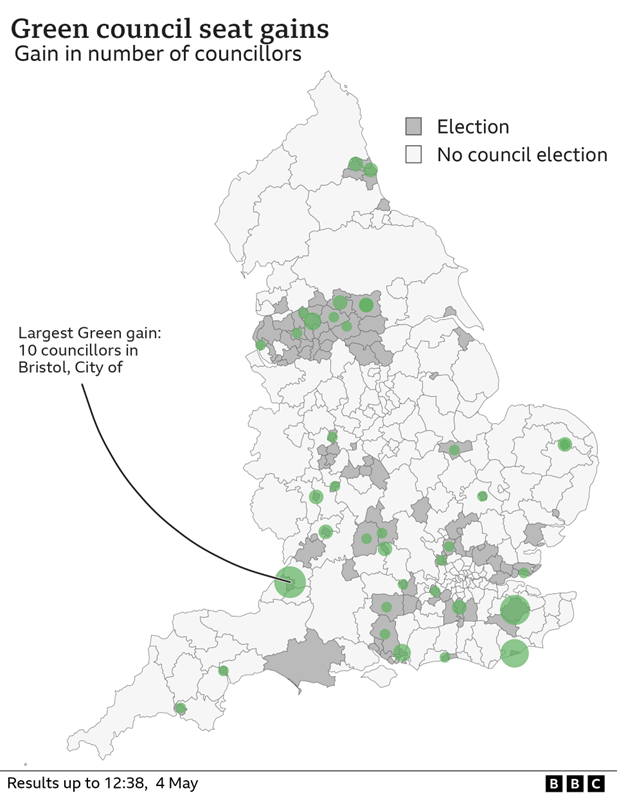
Greens are the largest group on key English councils such as Hastings, Stroud, East Hertfordshire, Babergh, East Suffolk, Mid Suffolk, Lewes, Folkestone and Hythe, the Forest of Dean and Bristol, where they were two seats short of winning an overall majority and will take the leadership of the council.
Greens candidates invariably offer practical policies to address local issues and, as can be observed on this electoral map from the BBC, this election has seen some interesting breakthroughs with seats won from both Labour and Conservative parties in South Tyneside, Exeter, Peterborough and Colchester.
Building the party’s strength in many different locations of the country with markedly different strategies, as is to be expected from a party based on a principle of local party autonomy, is a tactic that seems to have paid off.
However fielding candidates with such apparent different agendas can come at a cost as was evidenced in the London Mayoral election where Green candidate, Zoe Garbett, was pushed from 3rd place for the past three elections to 4th place by the Lib Dems. Damaging allegations of anti-semitism in Bristol, Peterborough and Leeds have also raised concerns about the selection process at local partry level.
This may raise questions about what the party stands for now that it is no longer a party primarily concerned with the environmental fate of the planet, as observed in a number of main media coverage of the party’s progress.
James Dennison from East Anglia University, a leading expert on the Green Party, commented that seeking to appeal to both Cameroonian Conservative remainers, Jeremy Corbyn’s refugees (not forgetting the LGBTIQA+ community) will be a hard balance to strike with the drafting of the General Election manifesto.
As the final results were announced, co-leader and parliamentary candidate for Waveney Valley, Adrian Ramsay, said : “We’ve had a really encouraging set of results, building on what we’ve seen over the last four sets of local elections where we have gained record numbers of Green Councillors each time.”
Your comments are welcome : TheGreenLightBLog@protonmail.com

 The Green Light