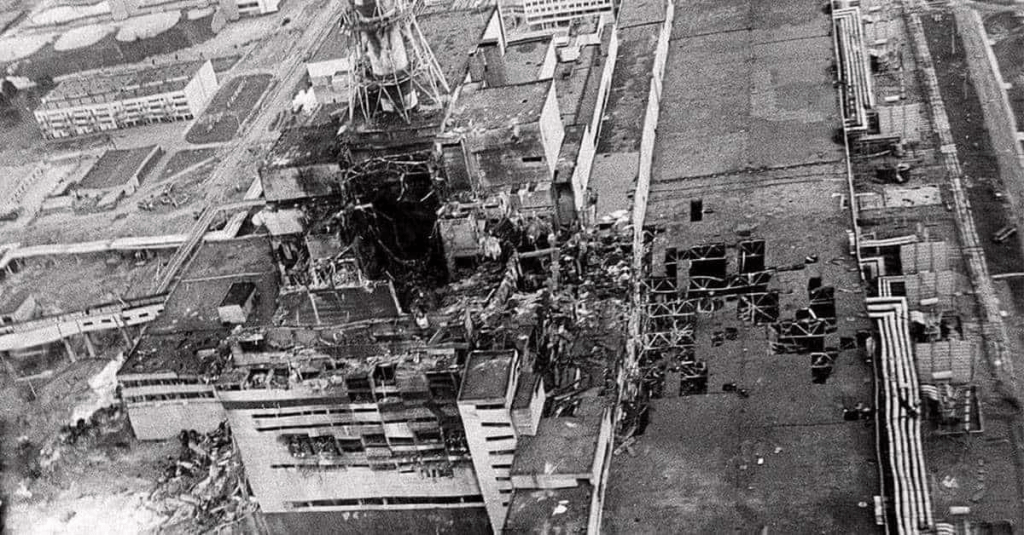
Chernobyl nuclear disaster 1986
Whilst much noise has been made of the ‘ Zionism is racism ‘ motion since approved by 1022 out of 1835 self-appointed attendees at the Autumn 2026 Green Party of England and Wales (GPEW), a profound policy change with regards to the threat of nuclear fission to the future of humanity and all living species has also been adopted. The motion was fast- tracked and approved quasi unanimously. Two third of attendees at this event were new recruits.
Opposition to nuclear energy and the building of power stations has always been a fundamental green policy. It has been the object of countless protests and campaigns from green activists for well over half a century. In the late 1950s and 60s, thousands of campaigners against nuclear power – women in particular – joined the Party for that reason alone.
Here is a disturbing video as to why greens should continue to oppose nuclear power in the UK here.
Proposed by Zac Stevenson-Barnes from About – Greens For Nuclear created in 2024 by unelected volunteers from the Energy Policy Working Group, motion C03 entitled ‘Electricity generation policy update’ called for an update of the Power section of the Energy Chapter of Policies for a Sustainable Society (EN010). The motion was backed by Alison Hockings, Max Jephtha, Don Humphreys and 55 others.
As per the Synopsis, the aim of C03 was to ‘ align the Power section with the Planetary Boundaries approach, remove blanket opposition to nuclear fission, and clarify criteria by which a Green government will assess new energy infrastructure…’.
The Motion Text reads:
“Update to Power Section of the Energy Chapter of Policies for a Sustainable Society
Currently EN010 reads ” in line with the move from fossil fuel, clean energy electricity generation will be substantially increased, based primarily on renewable. very low carbon sources with offshore wind as a major source, supported by onshore wind, marine, solar photo voltaic, bio fuels, hydro power and geothermal “.
Replace existing EN010 with:
EN010 in line with the shift to a more electrified energy system compatible with the UK’s Planetary Boundaries targhets, renewable and low carbon electricity generation will be substantially increased ( see EN013, CC013, EC202)
- Electricity generation will be based on offshore wind., onshore wind and rooftop solar photovoltaics. Other electricity generators that are considered low carbon include ground-mounted solar photovoltaics ( including car parks and agrivoltaics, hydroelectric power, nuclear fission, tidal power… ‘
Visitors to this post who are members of the GPEW can read the motion in full here.
A 4 pages long Amendment from members of the same Energy Policy Working Group was proposed by Toby Blint and co-proposed by 6 members : Owain Gwyn, Mark Barnes, Deolinda Eltringham, Sam Alson and Alexandria Thurnherr.
Buried in no less than 9 replacements and deletions of existing policies, the fundamental change of policy in support of nuclear energy can be found under ‘Consistency to the Industry Chapter’ at the bottom of page 150 and under IN407 on page 151.
The preamble to the amendment reads as follows:
‘Unlike the fossil fuel industry, which was conspicuously not mentioned in the old version of
IN211, there is not a strong consensus that the nuclear industry is unsustainable (see the
relevant thematic discussion below for more detailed consideration of this matter). Moreover, the old version of IN211 was non-specific and would also have encompassed other aspects of nuclear industry, such as nuclear medicine”.
The actual change came about with a simple deletion of two words: ‘ nuclear power ‘ as highlighted in bold in those 3 paragraphs:
IN407 currently reads “Industrial production should minimise embodied carbon….
fossil fuels and nuclear power “
From IN407 after fossil fuels, delete “and nuclear power”.
So that it becomes
IN407 Industrial production should minimise embodied carbon….fossil fuel
As if left in any doubt, the amendment confirms the motion’s rationale by adding:
“IN407 has been amended for consistency with new EN010 and to improve its own internal
consistency; nuclear power is a form of low carbon power.“.
As expected, the response to such fundamental change in the Party’s environmental policies has been warmly received by the nuclear industry and the main media.
In addition to overt “entryism” – as raised by former co -leader Adrian Ramsay and MP recently -,such reversal of long established opposition to nuclear fission made by less than 1% of the membership should be of some concerns about the influence of a growing number of unelected volunteers joining Policy Working Groups who also happen to be active members of unofficial lobby groups.
Besides green4nuclear, known groups who have made a decisive impact on Green Party’s policies at the 2026 Autumn Conference are the external company limited Green Organise and Greens4Palestine.
Had Conference been representative of the views of the whole membership and the hundreds of thousands of Local Parties’ members in particular, motion C03 would have been have properly scrutinised and debated. There is little doubt that switching from opposition to all things nuclear to supporting nuclear energy would never have been approved.
As longer serving members are resigning in drones since the Brighton Conference, many are no doubt doing so because of this reversal of policy on nuclear energy.
Such policies can and must be reversed. Hopefully, this will happen in 2028 when science and sanity might make a long awaited return.
Your comments are always welcome.
TheGreelightBlog@protomail.co


